


Hey there! As a supplier of wheat roller mills, I've seen firsthand how different factors can impact the performance of these machines. One key factor that often gets overlooked is the roller diameter. In this blog post, I'm going to break down what the influence of the roller diameter is on the performance of a wheat roller mill.
1. Basics of Wheat Roller Mills
Before we dive into the influence of roller diameter, let's quickly go over how a wheat roller mill works. A wheat roller mill is a machine used to grind wheat into flour. It consists of two or more rollers that rotate in opposite directions. The wheat is fed between the rollers, and the pressure and friction between the rollers break the wheat kernels into smaller particles.
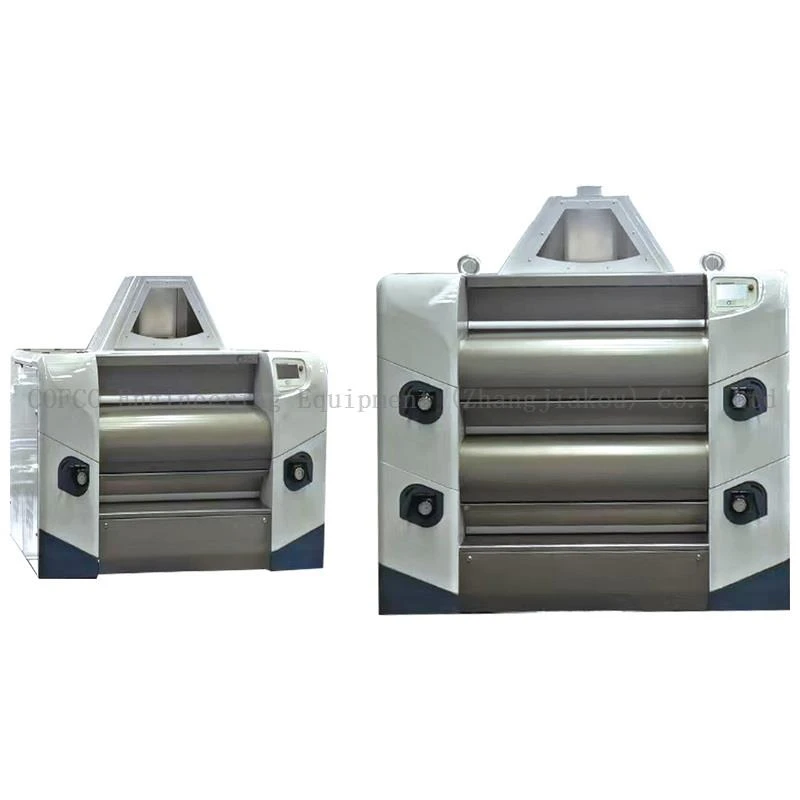
We offer a range of roller mills, like the MMT MMTL Roller Mill, MMV MMVL Roller Mill, and MMR MMRL Roller Mill. Each of these models has different features and specifications to meet various production needs.
2. Influence on Grinding Efficiency
The roller diameter has a significant impact on the grinding efficiency of a wheat roller mill. A larger roller diameter generally means a greater contact area between the rollers and the wheat kernels. This increased contact area allows for more effective grinding.
When the rollers have a larger diameter, they can apply more pressure over a wider area. This results in better fragmentation of the wheat kernels. The kernels are more likely to be broken down into smaller, more uniform particles, which is crucial for producing high - quality flour.
On the other hand, smaller roller diameters may not be as efficient. The contact area is limited, and the pressure applied may not be sufficient to break down the kernels completely. This can lead to uneven grinding, with some kernels remaining larger while others are over - ground.
3. Impact on Throughput
Throughput, or the amount of wheat that can be processed per unit of time, is another important aspect of a wheat roller mill's performance. Roller diameter plays a role here as well.
Larger diameter rollers can handle a higher volume of wheat. Since they have a greater contact area and can apply more pressure, they can process more kernels in a single pass. This means that a mill with larger diameter rollers can have a higher throughput, which is beneficial for commercial operations that need to produce large quantities of flour.
Smaller diameter rollers, however, may have a lower throughput. They can only process a limited amount of wheat at a time, which can slow down the production process. For small - scale operations, this might not be a big issue, but for large - scale commercial mills, it can be a significant drawback.
4. Effect on Flour Quality
Flour quality is a top concern for any wheat roller mill operator. The roller diameter can have a direct impact on the quality of the flour produced.

As mentioned earlier, larger diameter rollers can produce more uniform particle sizes. This is important because uniform particle sizes result in better - textured flour. The flour is smoother and has a more consistent quality, which is preferred by bakers and consumers alike.
In addition, larger rollers can also help in separating the different components of the wheat kernel more effectively. They can better separate the endosperm from the bran and germ, which is essential for producing high - grade flour.
Smaller diameter rollers may not be as good at achieving these results. The uneven grinding can lead to a flour with a less consistent texture and quality. The separation of the endosperm, bran, and germ may also be less efficient, resulting in a lower - grade flour.
5. Wear and Tear
The roller diameter also affects the wear and tear of the rollers. Larger diameter rollers generally have a longer lifespan. Since they have a larger surface area, the wear is distributed over a wider area. This means that the rollers don't wear out as quickly as smaller diameter rollers.
Smaller diameter rollers, on the other hand, are more prone to wear. The pressure is concentrated on a smaller area, which can cause the rollers to wear down faster. This can lead to more frequent roller replacements, which can increase the operating costs of the mill.
6. Energy Consumption
Energy consumption is an important consideration for any industrial machine, and wheat roller mills are no exception. The roller diameter can influence the energy consumption of the mill.
Larger diameter rollers may require more energy to operate. This is because they have a larger mass and need more power to rotate. However, the increased grinding efficiency and throughput can offset this higher energy consumption. In many cases, the overall energy cost per unit of flour produced may be lower with larger diameter rollers.
Smaller diameter rollers may consume less energy to rotate, but their lower efficiency and throughput may result in a higher energy cost per unit of flour produced.
7. Choosing the Right Roller Diameter
When choosing a wheat roller mill, it's important to consider the roller diameter based on your specific needs.
If you're running a large - scale commercial operation that requires high throughput and high - quality flour, larger diameter rollers are probably the way to go. They offer better grinding efficiency, higher throughput, and better flour quality.
For small - scale operations or home use, smaller diameter rollers may be sufficient. They are more affordable and may consume less energy. However, you may have to compromise on the throughput and flour quality to some extent.
8. Conclusion
In conclusion, the roller diameter has a significant influence on the performance of a wheat roller mill. It affects grinding efficiency, throughput, flour quality, wear and tear, and energy consumption. As a supplier, we understand the importance of choosing the right roller diameter for your needs.
If you're in the market for a wheat roller mill and want to discuss which model with the appropriate roller diameter is best for you, don't hesitate to reach out. We're here to help you make the right decision and ensure that you get the most out of your wheat roller mill.
References
- Smith, J. (2018). "Advances in Wheat Roller Mill Technology". Journal of Grain Processing.
- Johnson, A. (2019). "The Impact of Roller Diameter on Flour Production". Grain Science Review.